Sunday, 11 May 2014

Cooperative project Galician-English

We were helping Galician team teachers to create Correlingua pins.

We used a special white clay to start the process. 
They dried with air. We cut them with the help of milk bottle caps to give the shape.


After drying, we painted them on blue.
We let them dry...
We pasted the metal safety pin with silicone...


We already used the colour silicone to write beautiful Galician words on everybody's T-shirts.
This is the result, one for Laurent, the conversation assistant, who has Morriña. One for the teacher who loves firebutterflies, Lucecú.


We have to stick the Galician logo stickers.


Final work . Tomorrow, 13th May, we"ll have fun in Correlingua in Bueu.


Friday, 9 May 2014

English play for the oldest students

Yesterday 8th May, we went to IES As Barxas to enjoy the play "What's up Romeo?" with secondary students.


The teenagers play was really funny. Actors did it great!!! They conneted perfectly with the teenagers world...whatsapp, MP3, short messages...
 The music was very appropiate and the kids felt very confortable in the secondary atmosphere. 
They are ready for high school!!


Our kids from 5th and 6th grades understood perfectly the English play. We´d already studied and worked with vocabulary, videos, song from the play.


We all had a lot of fun enjoying, listening and reading short signs, singing and answering the questions the actors did. 

More... next year!!!!


Wednesday, 30 April 2014

Dalí's Windmills by 3rd & 4th graders


Fantastic pictures by Students from Tirán.
They made the versions of Dalí's picture.


Dalís in Tirán


First & second graders wanted to have "their own Dalí moustache".
They decided to colour Dalí's portrait very colourful.


At the English and Art class... Everything can happen...
2nd graders finishing their "Butterflies chases" wearing their own moustaches.


Very cooool!!!


                                                  Just... WOnDERfUL, kids!!!!!


Friday, 25 April 2014

Playground Games

Let's Play outside, openair is the best for kids. Enjoy!!!


When the SUN returns, I promise we'll do it outside in our wonderful playgrounds.


Wednesday, 23 April 2014

23rd April BOOK DAY

World Book Day

Choice of date[edit]

The connection between 23 April and books was first made in 1923 by booksellers in Spain as a way to honour the author Miguel de Cervantes who died on that day.[citation needed]

In 1995, UNESCO decided that the World Book and Copyright Day would be celebrated on this date the date is also the anniversary of the birth and death ofWilliam Shakespeare, the death of Miguel de CervantesInca Garcilaso de la Vega and Josep Pla, and the birth of Maurice DruonManuel Mejía Vallejo and Halldór Laxness.

Although 23 April is often stated as the anniversary of the deaths of both William Shakespeare and Miguel de Cervantes, this is not strictly correct. Cervantes died on 22 April and was buried on 23 April according the Gregorian calendar; however, at this time England still used the Julian calendar. Whilst Shakespeare died on 23 April by the Julian calendar in use in his own country at the time, he actually died eleven days after Cervantes because of the discrepancy between the two date systems. The apparent correspondence of the two dates was a fortunate coincidence for UNESCO.


World Book Day by country[edit]

Forum on reading aloud held outside the campus library at the Monterrey Institute of Technology and Higher Education, Mexico City for the occasion

Spain[edit]

To celebrate this day Cervantes' Don Quixote is read during a two-day "readathon" and the Miguel de Cervantes Prize is presented by the King in Alcalá de Henares.

In Catalonia, Spain, since 1436, St. George's Day has been 'The Day of the Rose', where the exchange of gifts between sweethearts, loved ones and respected ones occurs. It is analogous to Valentine's Day. Although the World Book and Copyright Day has only been celebrated since 1995 internationally, books were exchanged on 'The Day of the Rose' in Catalonia since at least the year 1926 in memory of Cervantes.

Sweden[edit]

In Sweden, the day is known as Världsbokdagen (World Book Day), and the copyright part is seldom mentioned. Normally celebrated on April 23, it was moved to avoid a clash with Easter to April 13 in the year 2000[2] and 2011.[3]

United Kingdom[edit]

In the United KingdomWorld Book Day is held annually on the first Thursday in March, to avoid the established international 23 April date due to clashes with Easter school holidays, and the fact that it is also the National Saint's Day of England, St George's Day.


23rd April 2014 Book Day Celebration 
in CEIP Plurilingüe Tirán

Today we have got cute reading activities for the kids to do in pairs. Library team have decided to join kids in pairs of a young child with an older one.
 Amazing idea!!!
It was great! The older one have read a book to his or her mate. Then both have made a picture about it. 
Teachers will do a kind of book with all the pictures sheets.

The end of the activities has been an English reading of the classic" Where the wild things are" by Laurent Palsen, our conversation assistent, in the school library with a visual help on the smart board.


This is the link where you can enjoy this classic book.


Our library is crowded.


The whole school has been there.

It was a wonderful Book Day 2014. 


Saturday, 19 April 2014

Tuesday, 15 April 2014

Awesome recycling Easter Bunny

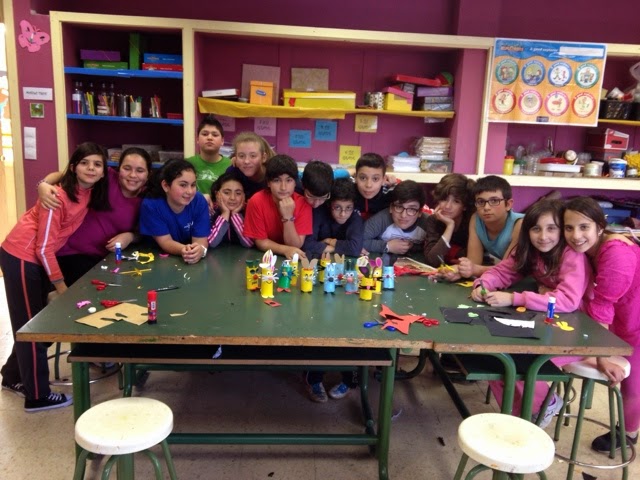
The oldest students made their own original Easter Bunnies. They received no directions, they could do whatever they wanted. These are the results:


They used a useful tool to paste by means of hot glue.

Amazing designs...


They enjoyed a lot while they made their creations.


Thank you, guys! 


You're great! Congratulations!!

Sunday, 13 April 2014

Easter around the World

http://www.elle.es/viajes/flechazos-news/semana-santa-mundo?utm_source=facebook&utm_medium=social-media&utm_content=broadcast&utm_campaign=new-article


Germany

In Germany, Easter is associated with traditional Easter eggs. One of the most deeply rooted traditions is that of the 'hunting Easter eggs', a game in which children seek decorated eggs leaving them hidden Easter Hare. Another of the most spectacular is the Easter tree or 'Osterbaum', consisting of decorated eggs hanging on the branches of a tree.
NY

New Yorkers are big fans of street parades. Besides its famous parade of Thanksgiving Day, they also celebrate Easter with another street show. Occurs around Fifth Avenue in Manhattan and it is not as organized as its namesake Thanksgiving event: rather, people go there without disguise too clear plan. However, it has become one of the great events of the year in the city but has already been stripped of the religious character it had in its early years.
Braga, Portugal

Our Portuguese neighbors have a more similar to our celebrations, but also have their peculiarities. In Braga, takes place the procession of Ecce Homo, in which men dressed in robes walking around the city honking ratchets: these are called 'farricocos'.
Czech Republic

Easter in the Czech Republic has a more pagan than religious, because during the communist regime any celebration for spiritual banned. Still, this season is full of traditions. One of the most striking is the pomlázka, a thin rod of willow with the boys 'whip' the girls to bring good luck.
Sydney, Australia

The religious aspect is not very powerful in Australia, but that does not mean that Easter celebration is not there. The Sydney Royal Easter Show, with plans that include a display of pigs, sheep shearing tournament or other less rural as concerts and culinary competitions: In fact, at that time a major event-based agricultural customs of the country takes place in Sydney .

Thursday, 10 April 2014

EASTER BUNNY

The youngest kids are making an Easter Bunny with recycling materials.
They are using toilet paper rolls, recycling colour paper, little pieces of eva rubber and wool for the whiskers.
They put some glue on the paper and wrap the roll, staple the ears and set the feet at the bottom.
They follow an example for cutting ears and feet.